


Social Theory explains why Nike's new DTC model is PERFECT
Defining Theories and Frameworks
Social Media Marketing Strategy generates marketing assets through customer engagement and social media interactions (Li, Larimo, and Leonidou 2020). It is the totality of marketing and social media and relies upon both to create and effective strategy. The purpose of marketing is to drive sales and social media is the lens through which that is done.
To effectively target audiences’ brands must understand consumption habits and the best way to reach the audience. Consumers want to connect to the brand and a successful social media strategy will integrate them. This is called narrative transportation. Narrative transportation is "when the consumer is absorbed into the narrative, becomes part of the story and lives the story from the inside" (Green & Brock, 2000). This creates an emotional connection and strengthens the brand consumer relationship (Heath, Brandt, and Nairn 2006). Throughout this case study we will take a look at how Nike approaches social media marketing and connects with consumers on different social platforms.
Setting the Stage for Nike
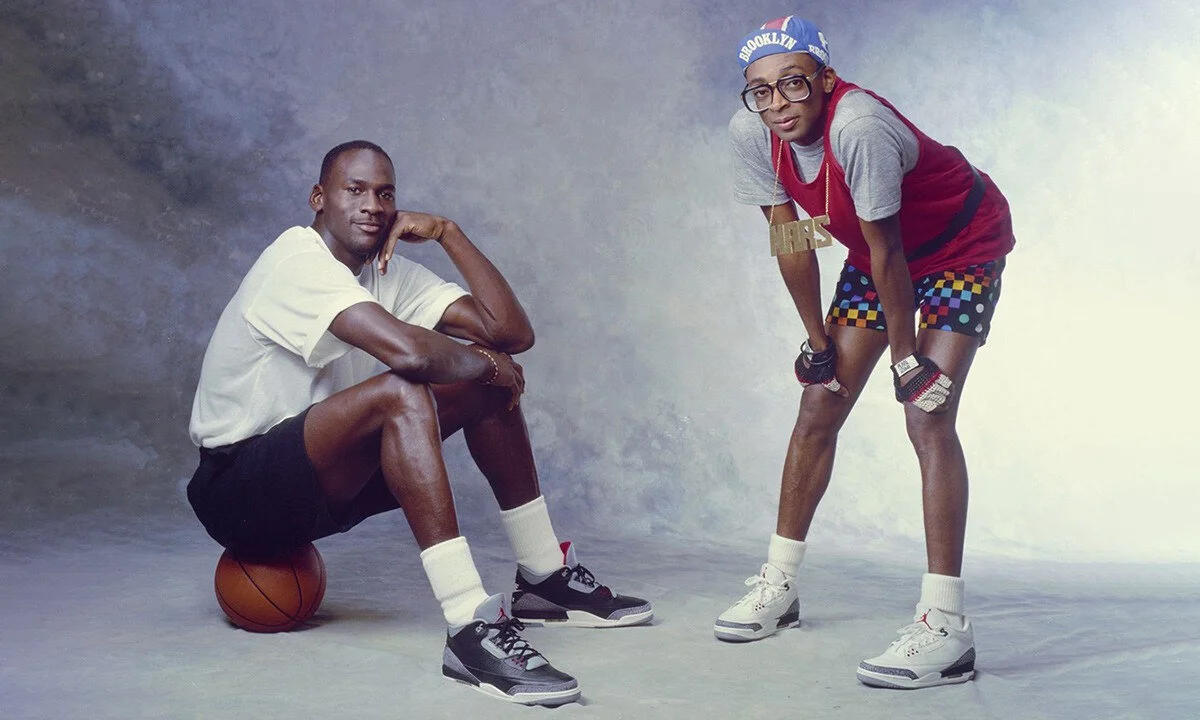
Emotional content drives consumer relationships (Heath, Brandt, and Nairn 2006). And no brand understands this more than Nike. Founded by Bill Bowerman and Phil Knight in 1964, Nike is one of the most recognizable brands on earth. Nike is a master at connecting with its consumers through emotion. One of its most impactful ads, “Is It The Shoes”, leveraged Michael Jordan’s brand power to catapult his signature shoe line into success. Nike learned early on that connecting with a consumer’s feelings motivates consumers to buy (Elliot 2010).
As we stepped into the new era of social media many retails stores began to shutter. In 2018 e-commerce garnered one hundred and twenty three billion dollars in sales (Ritcher 2018) while many brick and mortar establishments closed operations. Video and music stores are now a relic of the past while ecommerce sites have proven to have longevity. With this in mind, how does a multi billion dollar corporation like Nike get ahead of the curve?
In 2017 Nike unveiled a radical new strategy. Out of thirty thousand of its wholesale partners Nike planned to prioritize just forty. Nike outlined a plan to double direct connections with consumers, double the speed of production, and double its in house innovation (Business of Fashion 2020). What this means is Nike would have to adopt new ways to reach its consumers to increase online profits.
Nikes, Direct to Consumer (DTC), and Social Media
Decades ago a direct to consumer strategy was not possible for a multinational corporation. With social media companies have a direct line to the customer to create meaningful relationships. Social media marketing is essentially relationship marketing. Trying to sell products is not an effective strategy if there is no connection with the consumer (Gordhammer 2009). In order for this DTC strategy to work Nike has had to go all in on social. In an interview with the Nike’s CEO Phil Knight for Harvard Business Review, he mentioned, “We used to think that everything started in the lab. Now we realize that everything spins off the customer”.
Virality and Conversation
The average person sees around ten thousand ads a day (Forbes, 2017). Our eyes are trained to ignore most of the advertisement we see (Pernice, 2018). On social media where the average person can run an advertisement from New York and have it reach a screen in London it is important to cut through the noise. Since introducing their DTC strategy Nike introduces products with a story. The story draws you in and gives you a reason to connect with the brand. They know creating a story will lead to a conversation which will lead to sales of the product. Nike also knows that conversation is more impactful than a traditional ad (Coon,2010). For example, when Nike wanted to introduce the Hijab in 2017 they created a story about inclusivity in sports. They told the story through the champion fencer Ibtihaj Muhammad, and shared her struggles with wearing a traditional hijab while competing. This took social media by storm. On Instagram it spawned a hashtag, #nikeprohijab, with over six thousand user generated photos of women wearing their nike hijab. On the official Nike Women’s account post showing the Muslim Zeina Nassar has over two-hundred thousand likes. While those numbers may not seem impressive the conversation and change that came from these social media posts was what Nike wanted. Starting a timely conversation that goes viral about a Nike athlete all while capturing early adopters in a new market.
Since 2017 we have seen Nike implement story in their social strategy. These post are debuted on twitter and Instagram. From there Nike expects users to repost, comment, and discuss the products. Virality is not a strategy for most companies. But most companies are not Nike. From Colin Kapernick, to Serena Williams, to addressing covid-19. Nike has created stories that first demand a conversation, then they center those stories around the customers through the lens of a “hero”, which is almost always a Nike athlete.
Nike has almost two hundred million followers on its main and niche accounts with one-hundred and forty-three million followers on the main Nike account. The niche accounts include Nike skateboarding, Nike Football, Nike women, Nike court, and Nike basketball.
The main Nike account does not post frequently but each post is impactful. The post focus on its premier athletes and stories. With a little over seven hundred post the main Nike account has a .45% engagement rate which is great considering they have over one hundred million followers on that account. Nike is success at capturing the audience at the right place and the right time on this account. Nike is building relaitonships with the consumers through heartfelt and engaging post without bombarding them every week or even every month. They are building a relationship and valuing the viewers personal space without overloading them.(Heath, Brandt, and Nairn 2006).
The niche accounts have a different approach often focusing on user generated content (UGC). When developing a social media marketing strategy UGC is important as it absorbs the consumer into the narrative. This is called narrative transportation when the user is able to become a part of the story (Green and Brock 2000). This motivates consumers to produce content, which is free Nike advertising, for a chance to be reposted on a official Nike account.

While looking at the Nike Women’s account two things are noticeably different in this strategy compared to the main Nike account. The Nike Women (NW) account is predominantly UGC and each post tells a story. Nike uses story telling as a main component of its social strategy and the more niche social channels put customer at the core. These are everyday people who you are much more likely to interact with in real life at the center of a story (Green and Brock 2000). This is quite an effective strategy. Post feature models, mothers, community activist, musicians, artists, and everyday people all on one page. Each with their own story on their respective dedicated post. This creates a strong personal connection with Nike and stands out (Ardelet, Slavich, Kerviler 2015). As of February 2021, NW has over seven million followers with a .15% engagement rate. A look at the other niche Nike account will yield the same results.
SNKRS
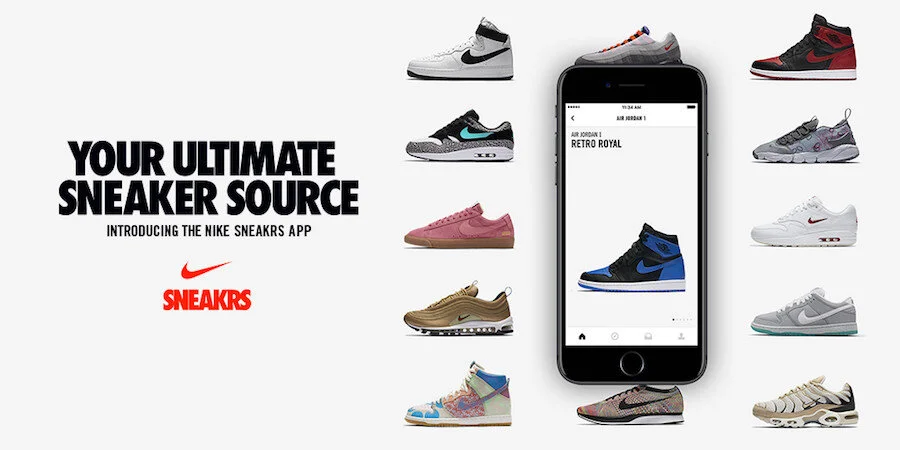
In an unironic way Nike uses the fact that people can not buy shoes to generate hype on social media. Every Saturday morning Nike’s SNKRS app trends because thousands of people are not able to purchase shoes. SNKRS released in 2015 as a “one stop shop” to all Nike footwear. This app serves as a hub for every Nike shoe available to buy. The catch is that to buy limited you must enter an online raffle that thousands of other people enter every Saturday morning. It opens at 10am and by 10:01am it is closed. This scarcity marketing tactic influences consumers to believe each limited sneaker is more valuable and gives them a positive perception of the shoe (Aggarwal, Jun, & Huh, 2011). Customers usually flood Instagram and twitter with pictures of the app saying “sorry you were not selected” or “your entry was selected”. Nike lets users take a screenshot because they expect people to post on other social platforms thus increasing the hype around their products.
Nike incentivizes consumers to engage in the app through other methods as well. It gives consumers the chance to be featured on the front page of the SNKRS app if they go on Instagram and post “SNKRSkickcheck” in their best outfit. This hashtag has over two-hundred thousand post thus serving as free promotion for Nike. Nike gets free UGC, there is no marketing cost, and the poster gets posted on the SNKRS app which gives them a sense of status thus an “equal exchange” (Homans, 1958). In addition to this it also further builds a connection with consumers by taking them off Instagram into a Nike exclusive app (Green and Brock 2000).
In regards to posting Nike is not very active on twitter. This seems like a missed opportunity for the brand. Twitter is where communities are built and conversations are started. However, Nike is very active in replying to users. The project a caring and fun tone whether assisting customers with technical issues or complimenting users in their Nike apparel.
YouTube
Sitting at one and a half million subscribers Nike boast over four-hundred millions views on YouTube. The primary strategy on YouTube is giving the products the center stage. From videos detailing how to wear the products to the behind the scenes creation of the products this is a stark contrast compared to the rest of their social channels. But, it makes sense. YouTube is the second biggest search engine after google (Forbes 2017).
Nike has not posted on Facebook since January of 2018. Facebook has over two billion monthly users (Facebook 2020) so it can be assumed that Nike runs ads on Facebook but does not see a benefit in posting content.
Pinterest is the third biggest social media platform in the United States and has over three-hundred million monthly users world wide (Hootsuite 2020). Pinterest is essentially an online moodboard where users can upload, save, and “pin” content that they like on a digital moodboard. Where most companies ignore Pinterest Nike has taken a different approach. Nike uploads small campaigns to the site as they are relevant and removes them after they become obsolete. At this moment they only have three campaigns online. Unlike Instagram there is no user generated content because the strategy is to get Pinterest user to repost and save the content. Nike strictly uses promotional shots to give an aspirational feeling so users will want to pin content on their moodboard.
Collaborations With Influencers
Big campaigns while effective don’t have the reach of small campaigns (Gordhammer 2009). A number of small localized campaigns can have the same effect as a big campaign while creating real connections with a number of audiences instead of one big general campaign. We are well beyond the point of debating if influencers are necessary. Influencers can help brands reach untapped audiences and help capture market share. Nike has gone past strictly seeding influencers. They collaborate with them. Influencers with large audiences are masters at maximizing engagement, and have a great organic reach without any ad spend (Campbell and Farrell 2020).
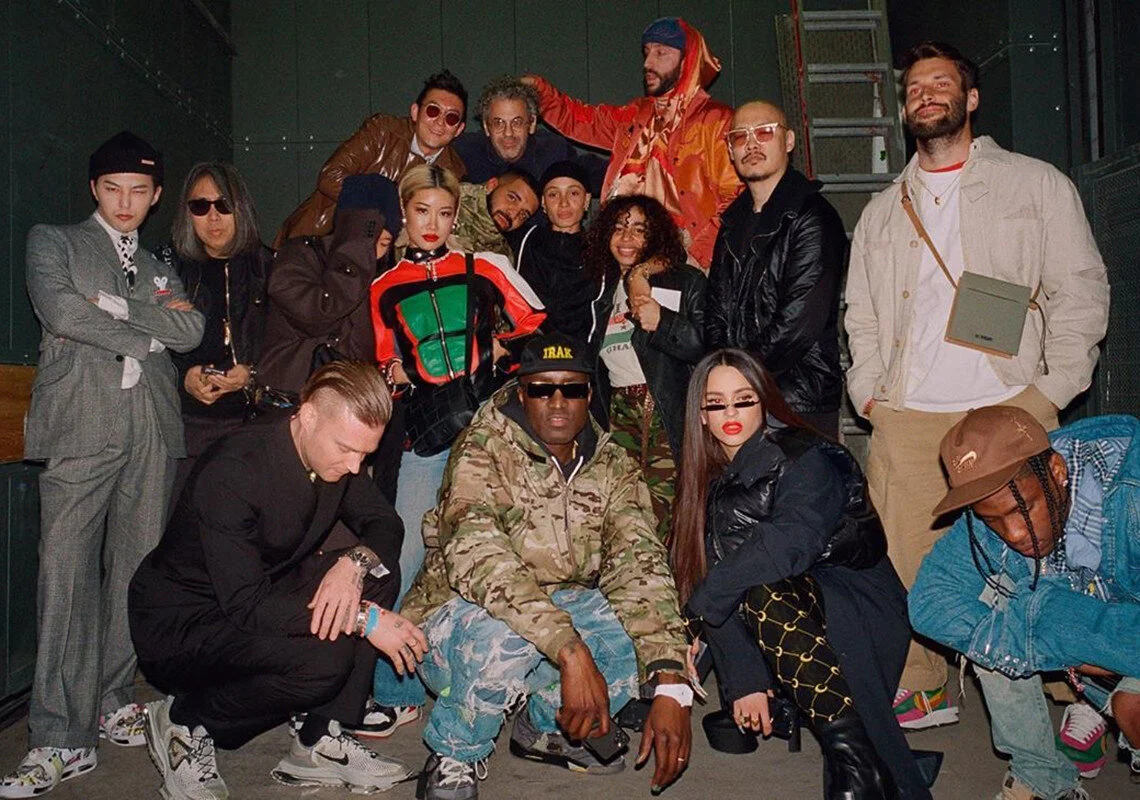
Early in 2020 before the pandemic fully arrived a picture from a secret Nike dinner was posted. At this dinner was Drake (a musician), Yoon Ahn (Tokyo based designer), Virgil Abloh (American designer), G-Dragon (K-pop star and designer), and Tom Sachs (Contemporary artist). This seemed insignificant from the outside looking in. But what is emerging from this picture is a series of collaborations around the globe for niche audiences. Each collaboration has its own marketing campaign and each designer is able to authentically connect their individual audience with Nike. The campaign created for Drake’s collaboration touched on UK culture and resonated with that audience. The campaign for Yoon Ahn touched more specifically on high end streetwear and has produced a cult classic sneaker. All under the Nike umbrella, these campaigns were able to reach different audiences because of the specific following each individual has. When a consumer follows an influencer it is because they align with the preferences of that influencer. The influencer knows how to produce content that appeals to their audience (Zhu & Chen, 2015), and brands are able to leverage that into sales (Campbell and Farrell 2020).
Evaluation
Nike has a well-integrated social strategy. Overall, they are consistent in tone and messaging. It is clear that Instagram, Twitter, and YouTube are the main platforms they are most active. On any of the Instagram pages you will see the brand use an aspirational and inspiring tone. Content and communication is diverse which promotes viewer stimulation and brand connection (Lim and Childs 2020). Nike is not overly active on any social platform. The brand really values the viewers time and that reflects in post frequency and quality. Frequent meaningless post would weaken brand strength (Heath, Brandt, and Nairn 2006). Nike talks when it has a purpose on socials.
In 2020 despite the ongoing pandemic Nike saw an eighty three percent jump in online sales. Ecommerce sales rose up eighty percent from 2019 (Business of Fashion 2020) became responsible for 30% of Nike’s total sales (Fortune 2020). The social strategy Nike has adopted since 2017 should be considered a success. From guaranteed virality with their emotional advertisements, conversations they start on social media by taking stances on social issues (ie Colin Kapernick and the Nike pro hijab), and from user generated content. Nike has a fantastic social media strategy that is proven to increase sales. Nike is giving consumers different experiences, visuals, and building communities throughout social media. And Nike will strategically analyze those communities to develop in person experiences. Nike has plans to open a Nike Women’s store as it plans to accelerate digital growth and have e-commerce total fifty percent of all sales (Business of Fashion 2020).
Your analysis will end with recommendations for the company or organization as to what they can do differently or improve in their social media strategy
Nike needs to capture the Chinese market. China was among the first regions to have 4g and 5g capabilities on their cell phones. The digital native youth of China are social media obsessed. Studies in China have shown that sixty-four percent of mobile phone owners use their phones to do online shopping (Hootsuite 2020). The same study showed that seventy-eight percent of mobile phone owners use WeChat (Hootsuite 2020). WeChat, Chinas premiere social media app, has over one billion monthly users (Business of Apps 2020). Brands like Dior have seen success from developing a China specific social media strategy and using celebrities to endorse their products (Business of Fashion 2019). It only makes sense to attempt to capture audiences in one of the most populated countries on earth. A strong social media presence in China will help Nike reach their fifty percent e-commerce goals ahead of projection.
Nike is one of the most innovative and forward thinking companies on earth. Yet, it has completely abandoned Tik Tok. The last post on the official Nike Tik Tok page was in March of 2020. The start of the pandemic. It seems like an obvious missed opportunity for Nike to build brand equity on Tik Tok during the beginning of the pandemic. Taking a look at the post from the past. They have all performed well. The post were fun, light hearted, not product centric, and easily digestible content. Nike needs to develop a Tik Tok strategy. Tik Tok is the sixth largest social media platform and has over four-hundred daily users in China alone (Hootsuite 2020).
Nike needs to develop a China centric social media strategy. Celebrity endorsements, especially in regards to fashion, are extremely successful and go viral on local Chinese social media apps (Wu 2020). Celebrity endorsements and collaborations exclusive to China would help capture the market. And those same endorsers would be able to create marketing assets that abide by local laws, cater to Chinese audiences (Zhu & Chen, 2015), and it would be at zero cost to Nike (Campbell and Farrell 2020).
Conclusion
The social media landscape continues to evolve and as it does brands will continue to search for how to cut through the noise. The average person saw ten thousand advertisement per day (Forbes, 2017) before the pandemic. Naturally with increased screen times that number has had to rise drastically. Nike’s strategy is authentically connecting with the consumer to sell products (Gordhammer 2009), and meeting them where they are. Nike strategically creates human centric stories to get customers emotionally invested and create a conversation (Coon,2010) that will take place on social media. Through Instagram they are able to repurpose user generated content and create meaningful relationships with consumers (Li, Larimo, and Leonidou 2020). On the SNKRS app Nike repost actual customers onto their third party app further immersing consumers into the Nike world (Green and Brock 2000).
Green, M.C. and Brock, T.C. (2000). The role of transportation in the persuasiveness of public narratives. Journal of Personality and Social Psychology, 79(5), pp.701–721.
Kim, J.-E., Lloyd, S. and Cervellon, M.-C. (2016). Narrative-transportation storylines in luxury brand advertising: Motivating consumer engagement. Journal of Business Research, 69(1), pp.304–313.
Ardelet, C., Slavich, B. and de Kerviler, G. (2015). Self-referencing narratives to predict consumers’ preferences in the luxury industry: A longitudinal study. Journal of Business Research, 68(9), pp.2037–2044.
Lim, H. and Childs, M. (2020). Visual storytelling on Instagram: branded photo narrative and the role of telepresence. Journal of Research in Interactive Marketing, ahead-of-print(ahead-of-print).
Jing Daily. (2020). Celebrity Endorsements Are Drastically Changing In China. [online] Available at: https://jingdaily.com/why-celebrity-endorsements-are-drastically-changing-in-china/.
socialwork.tulane.edu. (n.d.). What Is Social Exchange Theory? [online] Available at: https://socialwork.tulane.edu/blog/social-exchange-theory#:~:text=The%20genesis%20of%20social%20exchange.
Iqbal, M. (2017). WeChat Revenue and Usage Statistics (2019). [online] Business of Apps. Available at: https://www.businessofapps.com/data/wechat-statistics/.
Sehl, K. (2020). 20 Important TikTok Stats Marketers Need to Know in 2020. [online] Hootsuite Social Media Management. Available at: https://blog.hootsuite.com/tiktok-stats/.
courses.businessoffashion.com. (n.d.). BoF Education. [online] Available at: https://courses.businessoffashion.com/courses/take/case-study-dior-china-digital-strategy/pdfs/9631007-case-study [Accessed 18 Feb. 2021].
DataReportal – Global Digital Insights. (n.d.). Digital 2020: China. [online] Available at: https://datareportal.com/reports/digital-2020-china#:~:text=There%20were%201.04%20billion%20social [Accessed 18 Feb. 2021].
BoF Education. (n.d.). Inside Nike’s Radical Direct-to-Consumer Strategy | Online Course | #BoFEducation. [online] Available at: https://www.businessoffashion.com/education/courses/case-study-nike-direct-to-consumer-sportswear-mark.
Hootsuite Social Media Management. (2019). 23 Pinterest Statistics That Matter to Marketers in 2019. [online] Available at: https://blog.hootsuite.com/pinterest-statistics-for-business/.
Wagner, A. (n.d.). Council Post: Are You Maximizing The Use Of Video In Your Content Marketing Strategy? [online] Forbes. Available at: https://www.forbes.com/sites/forbesagencycouncil/2017/05/15/are-you-maximizing-the-use-of-video-in-your-content-marketing-strategy/?sh=185a758d3584 [Accessed 18 Feb. 2021].
Laros, F.J.M. and Steenkamp, J.-B.E.M. (2005). Emotions in consumer behavior: a hierarchical approach. Journal of Business Research, [online] 58(10), pp.1437–1445. Available at: https://www.sciencedirect.com/science/article/pii/S0148296304001092 [Accessed 27 Jan. 2020].
Heath, R., Brandt, D. and Nairn, A. (2006). Brand Relationships: Strengthened by Emotion, Weakened by Attention. Journal of Advertising Research, 46(4), pp.410–419.
Zhu, Y.-Q. and Chen, H.-G. (2015). Social media and human need satisfaction: Implications for social media marketing. Business Horizons, 58(3), pp.335–345.
Elliott, R. (1998). A Model Of Emotion-Driven Choice. Journal of Marketing Management, 14(1-3), pp.95–108.
Wolf Street (2018). Here’s which brick-and-mortar retailers are getting hit the hardest - Business Insider. [online] Business Insider. Available at: https://www.businessinsider.com/brick-and-mortar-retailers-getting-hit-the-hardest-2018-5.
Fortune. (n.d.). How Nike hit its e-commerce goal 3 years early. [online] Available at: https://fortune.com/2020/09/23/nike-q1-ecommerce-results-covid-19/.
Gordhamer, S. (2009), “4 Ways Social Media is Changing Business”, retrieved from http://Mashable.Com/2009/09/22/Social-Media-Business/(accessed on 02 March 2011).
Coon, M. (2010), Social Media Marketing: Successful Case Studies of Businesses Using Facebook and YouTube With An InDepth Look in the Business Use of Twitter, Communication M.A. Project, June 4, 2010, http://comm.stanford.edu/coterm/projects/2010/maddy%20coon.pdf (accessed on 02 March 2012).
Simpson, J. (n.d.). Council Post: Finding Brand Success In The Digital World. [online] Forbes. Available at: https://www.forbes.com/sites/forbesagencycouncil/2017/08/25/finding-brand-success-in-the-digital-world/?sh=65ae0de9626e [Accessed 18 Feb. 2021].
Pernice, K. (2018). Banner Blindness Revisited: Users Dodge Ads on Mobile and Desktop. [online] Nielsen Norman Group. Available at: https://www.nngroup.com/articles/banner-blindness-old-and-new-findings/.
Campbell, C. and Farrell, J.R. (2020). More than meets the eye: The functional components underlying influencer marketing. Business Horizons, 63(4).


Case Study: Savage X Fenty

Branding and Connecting to Consumers
Clothes offer consumers the opportunity for self-actualization. Self-actualization derived from Maslow's hierarchy, it manifests through one's realization of potential and appreciation for life (Maslow 1962). Clothing has gotten the reputation of being superficial when it is inherently intimate and telling. Apparel is draped over the skin. Humans spend more of their lives clothed than naked. Proximity of clothing to self (PCS) is the "psychological closeness of clothing to self" (Lee and Sontag 2007). Through research, PCS was found to be linked to identity, self-esteem, and mood (Sontag and Schlater 1982).
If apparel is the manifestation of people's personalities, it is vital that brands have identities to connect with consumers. A strong brand personality will allow consumers to see their true selves, and it is crucial to cut through the noise in the social media age. Relatively, we are still at the inception of social media, and "To increase self-brand connection, social media communication should be designed with diverse elements to promote viewers' active simulation and create meaning to the branded photo story" (Lim and Childs 2020).
Setting the Stage
Roy Raymond launched Victoria secret in 1977. Its brand values were inherently unrealistic from ideation. It was an unachievable fantasy that sold a lifestyle to consumers through the use of extremely skinny models. How could a man possibly design functional lingerie? How could a man even understand what women want in lingerie? From its creation, Victoria's Secret was never a brand for women, yet its media presence propelled the brand into unfathomable heights. The brand is the quintessential definition of the "Male Gaze." A term penned by Laura Mulvey to describe the cinematic depicting of women from a heterosexual male's perspective. This would only be amplified with the introduction of the Victoria Secrets fashion show in 1995. In its 26 years, the average model size became slimmer year after year compared to the average American woman size increasing (Maymone, Laughter, Anderson, Secemsky, and Vashi 2019). As beauty standards began to change, the unrealistic portrayal of women caused more tension between brands and consumers. Victoria's Secret never adapted and set the stage for a new brand to enter the market.

The Case for Savage X Fenty
Savage X Fenty launched in May 2018. The Joint venture between Rihanna and the California-based TechStyle group saw almost immediate success with seventy million dollars in funding that year (The Business of Fashion 2019), and as of February 2021, will be securing an additional hundred million dollars in funding from the LVMH group (The Business of Fashion 2021). Savage X Fenty launched with the values of confidence, fearlessness, and inclusion. A stark contrast from its main competitor. With these values and a woman at the helm of the brand. They have used social media to disrupt the market and tell real human stories.
Narrative Transportation and Frameworks
When consumers are able to immerse themselves in a story, they will immediately connect with the brand. Narrative transportation is "when the consumer is absorbed into the narrative, becomes part of the story and lives the story from the inside" (Green & Brock, 2000). Imagine how consumers can live in the story when they see someone who represents them in promotional materials or even sees themselves via user-generated content. The narrative transportation theory is an essential part of the storytelling of the brand. This brand is about eliciting confidence and making its consumer feel "sexy" even if they are not the size of a model.
The story Savage X Fenty tells must be looked through the lens of Freytag's pyramid in addition to the narrative transportation theory. Freytag's pyramid has five major points: Exposition, Initial Incident, Rising Action, Climax, Falling Action, Resolution, and Denouement.
• Exposition is the background information that sets the stage for the story. In this case, it is the astronomical rise of Victoria's Secret.
• Initial incident is defined by the first conflict. Although it took decades for this conflict to arise entirely. The male gaze's problems, unrealistic expectations, and overt sexualization have slowly caused tension between the brand and consumers.
• Rising action adds tension to the story. With the average Victoria's Secret model size slimming annually in contrast to the average American woman size increasing, consumers became extremely frustrated with the brand and its unrealistic portrayal of women.
• Climax is the turning point. This is the stage we are currently in. In the market, we have a disruption. Rihanna released a lingerie line and immediately began to take market share from Victoria's Secret.
• The story has yet to develop further, but with additional funding from the LVMH group, it is expected that Victoria's Secret will fold sooner rather than later.
Fenty uses a mix of user-generated content and promotional images to cut through the traditional marketing promotion and directly speak to their customers. With just under four million followers and a 1.13% engagement rate (Social Blade 2021), the most noticeable thing is how sensitive the brand is with its customers. On a repost of user-generated content, the brand voice exudes sexiness, but the captions empower the original poster. The captions do not make it a point to highlight that a man is in the products or that a woman of a different body shape is in lingerie. The brand voice is consistent without gimmicks. It tells customers that these products will make you feel great about yourself, free of gimmicks.
Brands are projected to spend fifteen billion dollars on ad spend in 2021 (Business Insider 2021). A part of Fenty's social strategy is also influencer seeding. From high-end influencers to micro-influencers. Anyone can get a campaign deal with Fenty because Fenty is for everyone. This aggressive strategy has without a doubt increased brand awareness while maintaining brand values. Seeing a plus-sized influencer with the products on and scrolling down two posts later to see Gigi Hadid in the same products promote inclusion without directly saying it.
On Twitter, the brand is not as successful. With around two hundred thousand followers, the brand has extremely low engagement rates, with the average tweet receiving under one thousand likes. Of all places to tell a brand story, Twitter is the place, but it is not utilized. No narrative threads on the behind the scenes making of a collection, not much reposting of user-generated content, and not much interaction with fans. One could imagine the main reason is for the protection of the fans. Twitter is a heavily unfiltered platform that can lead to harassment of its customers. One wrong post could go viral for all the wrong reasons and seemingly strip the original poster of the content of all of their confidence. After all, Twitter is notorious for having sizeable viral post where thousands of people attack one person. Consumers self-esteems are boosted from clothing (Sontag and Schlater 1982), and naturally self-esteems are broken from human interaction. So, is this to protect its audience?
YouTube and Tik Tok
Upon searching the brand on YouTube, thousands of videos appear from fan made content. This may not seem ideal since these videos overshadow the post from the official account. However, it further enhances the narrative that this brand is for everyone. Users can comb through videos, find someone they identify with and get a more accurate idea of how products will fit them. This representation no doubt psychological gives viewers a connection with the brand since they can see themselves in it (Lee and Sontag 2007). In regards to the account's official post, it will mirror the organic unpaid user generated content. With videos ranging from seven thousand views to over two million views, the brand is slowly building traction instead of trying to dominate the entire market.
The Tik Tok strategy is quite effective. The brand uses influencers to make fun content in the apparel. The posts are fun and sexy without being lewd. The content is exceptionally relatable, fun, and each post, regardless of gender, garners thousands of views and likes. This relatable content connects viewers and can potentially convert to purchases (Ardelet, Slavich, Kerviler 2015).
Integrated Strategy
Luxury goods have been proven to boost women's and men's self-esteem (Kim, Lloyd, and Cervellon 2016). Savage X Fenty uses user-generated content as the primary tool used to tell the story. The marketing mix that involves promotional pictures, user-generated content, and unpaid media all promote the brand narrative. With the created trust and equity Savage X Fenty is able to trigger narrative transportation, ingratiate viewers into the world, and sell products and experiences (Green & Brock, 2000).
Staying true to the brand's disruptive roots, it hosted the Savage X Fenty fashion show. Unlike its contemporaries, this fashion show is streamable on Amazon. Viewers are absorbed into the narrative. The world's first exclusive lingerie runway show that viewers can watch from the comfort of their home. It gives audiences the feeling of not only being front row at a runway show but a well thought out experience (Green & Brock, 2000). The show is a blend of a musical concert (true to Rihanna's nature) and a runway show. On the runway were models of all races, heights, shapes and sizes. It was an actual representation of the world undoubtedly making its viewers connect with the brand. Referring to the PCS theory, we can conclude that viewers felt an intense closeness to this runway show, because they were able to see themselves (Lee and Sontag 2007). Although viewership data is not publicly available the show was nominated for an Emmy further proving its impact. At the core we see that this brand puts people first in every way to deliver an experience.
Evaluation
Savage X Fenty is successful in immersing consumers into its brand story. Its social strategy follows the narrative transportation theory by ingratiating consumers in its story through representation. A representation that was not found for decades. By establishing the brand on values of representation, confidence, and diversity, Savage X Fenty was able to become a real competitive disruptor in the lingerie market. With this information, it is clear that the brand is targeting younger millennials and gen-z. This is a long-term strategy. Gen-Z's values lie in inclusivity and diversity (Lim and Childs 2020). As the generation ages, Savage X Fenty will have inherited a whole new generation of buyers.
With the constant social evolutions, the brand has seen success through putting people first and content differentiation. Although Twitter seems subpar, this feels intentional. In order for the brand to be a safe space, not posting user generated content on Twitter protects its consumers. Protects from harassment, bullying, and an assortment of potential comments. Protecting and nurturing the consumer's mental state is a part of evoking confidence.Unlike other brands, they have a significant Tik Tok presence that will undoubtedly grow as the brand capture more market share.
Conclusion
In the social media age, narrative transportation is a powerful tool to connect with consumers and create a profitable lifetime value. Studies show consumers have a desire for new experiences, but to have a brand that stands out, a personal connection needs to be made (Ardelet, Slavich, Kerviler 2015). This brand understands PCS (proximity of clothing to self) and has implemented it in its values (confidence, diversity, fearlessness) and storytelling.
By looking at this story through the lens of Freytag’s pyramid we see that the stage has been set for a new brand to enter the market. Savage X Fenty emerged as a disruptor and alternative to Victoria's Secret. By using Freytag's pyramid in addition to the transportation narrative theory, it is clear that Savage X Fenty tells the story of confidence, fearlessness, and inclusivity through authentic storytelling. Their social following and engagement on each social platform show that real people are connecting with the content. It is a long term strategy for natural growth. By telling real authentic stories, the brand will emerge as a market leader.
Bibliography
Maymone, M.B., Laughter, M., Anderson, J.B., Secemsky, E.A. and Vashi, N.A. (2019). Unattainable Standards of Beauty: Temporal Trends of Victoria’s Secret Models from 1995 to 2018. Aesthetic Surgery Journal. [online] Available at: https://academic.oup.com/asj/advance-article/doi/10.1093/asj/sjz271/5611156 [Accessed 29 Jan. 2020].
The Business of Fashion. (2019). LVMH’s Secret Rihanna Project: New Details Emerge, and Why It’s a Smart Move. [online] Available at: https://www.businessoffashion.com/articles/luxury/why-lvmhs-secret-rihanna-project-makes-sense [Accessed 14 Feb. 2021].
The Business of Fashion. (2019). Rihanna: 1; Victoria’s Secret: 0. [online] Available at: https://www.businessoffashion.com/reviews/fashion-week/rihanna-savage-fenty-victorias-secret [Accessed 14 Feb. 2021].
The Business of Fashion. (2021). LVMH and Rihanna’s Fenty Fashion: What Went Wrong? [online] Available at: https://www.businessoffashion.com/articles/luxury/lvmh-to-close-rihannas-fenty-fashion-house [Accessed 14 Feb. 2021].
Lee, Y.-A. (2009). Exploratory Correlation Analysis among Age Identity, Proximity of Clothing to Self, and Self-Actualization for Older Persons in the United States. Journal of the Korean Society of Clothing and Textiles, 33(12), pp.1897–1909.
Sontag, M.S. and Schlater, J.D. (1982). Proximity of Clothing to Self: Evolution of a Concept. Clothing and Textiles Research Journal, 1(1), pp.1–8.
Lee, Y.-A. (2009). Exploratory Correlation Analysis among Age Identity, Proximity of Clothing to Self, and Self-Actualization for Older Persons in the United States. Journal of the Korean Society of Clothing and Textiles, 33(12), pp.1897–1909.
Lim, H. and Childs, M. (2020). Visual storytelling on Instagram: branded photo narrative and the role of telepresence. Journal of Research in Interactive Marketing, ahead-of-print(ahead-of-print).
Green, M.C. and Brock, T.C. (2000). The role of transportation in the persuasiveness of public narratives. Journal of Personality and Social Psychology, 79(5), pp.701–721.
Kim, J.-E., Lloyd, S. and Cervellon, M.-C. (2016). Narrative-transportation storylines in luxury brand advertising: Motivating consumer engagement. Journal of Business Research, 69(1), pp.304–313.
Ardelet, C., Slavich, B. and de Kerviler, G. (2015). Self-referencing narratives to predict consumers’ preferences in the luxury industry: A longitudinal study. Journal of Business Research, 68(9), pp.2037–2044.
Link to inforgraphic: https://www.canva.com/design/DAEWJx6WrQM/share/preview?token=pffppWCtv1RaliWO8JpaFw&role=EDITOR&utm_content=DAEWJx6WrQM&utm_campaign=designshare&utm_medium=link&utm_source=sharebutton